
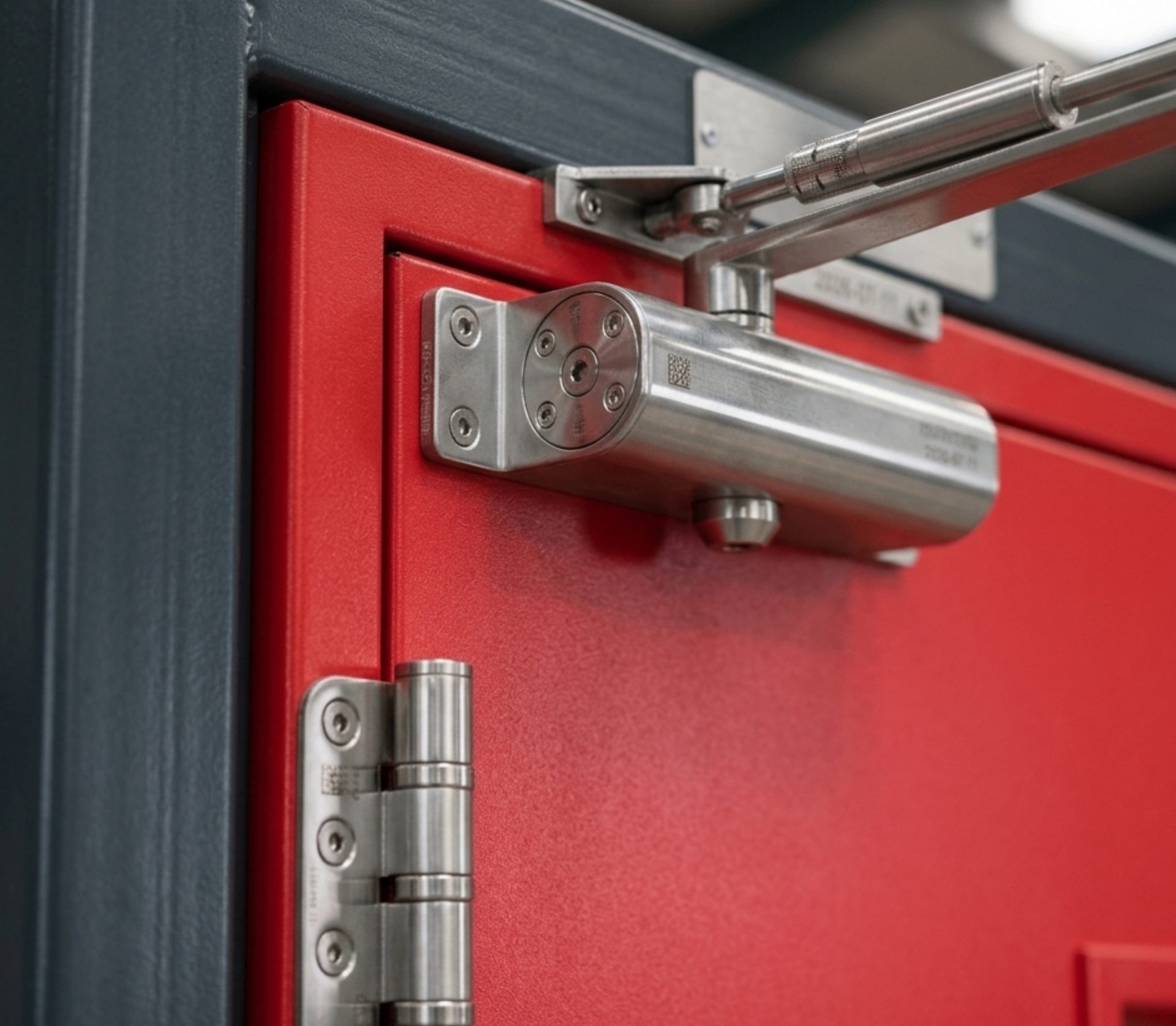
A smoke seal for a fire door works at room temperature; an intumescent strip does nothing until it is heated. The smoke seal closes the perimeter against cold smoke and draught the moment the leaf shuts. The intumescent strip stays inert, then expands in the fire to fill the gap the leaf has left behind. IS 3614:2021 requires both.
That answer gets muddled on site because most of what ranks for this question is written to British retail practice. India has its own text, and it is unusually specific about seals. What follows is every seal provision in IS 3614:2021 with its clause number, where each seal sits on the doorset, what the fire test report has to say about it, and the one performance requirement the standard states without naming a test method for it.
Two components, two temperatures
The two products are often supplied co-extruded in a single carrier and then treated as one item on a bill of quantities. They are not one item. They act against different things at different points in the same event, and one of them is working during the minutes that decide whether people get out.
Read together, the definitions settle the argument. An intumescent strip alone leaves a cold building with an open perimeter. A smoke seal alone leaves a burning doorset with a gap that nothing closes once the gasket has degraded. Note 1 to Clause 7.2.6 says exactly that: all fire doors are required to have smoke seal and intumescent seal as standard components of the door assembly.
Every seal provision in IS 3614:2021
Two of those rows carry more weight than the rest. Clause 7.2.4 puts the smoke seal into the frame design itself: door frames shall have a grooved profile with provision for smoke seal, in single or double rebate, all tested as an assembly. A frame rolled without that groove cannot be made compliant later by sticking a gasket to its face. Clause 7.6 then states the performance requirement in one line, that the performance of fire doors shall include smoke check, and extends fire rated smoke check sealing to every type of fire door the standard covers.
There is also a genuine inconsistency in the text worth knowing before a technical meeting. Clause 7.2.6 makes the intumescent seal mandatory for insulated doors and its Note 1 extends both seals to all fire doors, while Clause 9.3.1.1 in the installation section says that with the exception of uninsulated fire doors it is recommended that all fire doors are fitted with intumescent seals. The specification clauses in Section 7 are the binding ones; Section 9 is guidance on storage, handling and installation. Quote 7.2.6 when a supplier offers an uninsulated doorset with no intumescent run and calls it compliant.
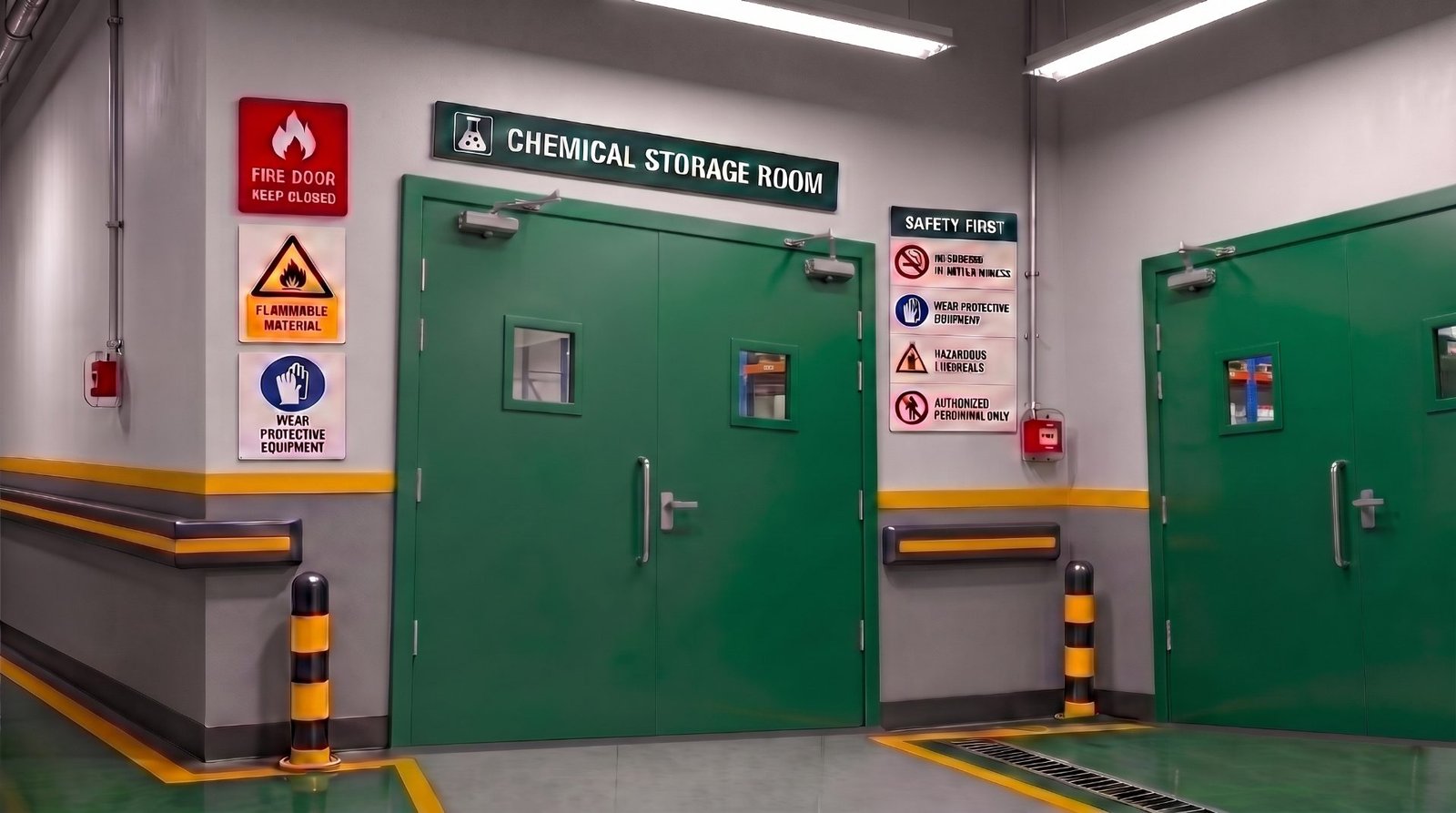
The intumescent seal belongs to the test report
Clause 7.2.6 contains the sentence that should govern procurement: it is essential that the intumescent seal to be used is of the same formulation, dimensions and configuration as that in the door manufacturer's fire test report. The seal is not a consumable chosen at despatch. It is a tested component of a tested assembly, and substituting a visually similar strip from another supplier produces a doorset that was never tested in that form.
The standard enforces this through its paperwork. The test certificate format at Annex C asks the manufacturer to declare the intumescent seal size and model, noted as applicable to insulated doors only, and separately the smoke seal model and specification. Two distinct lines, because they are two distinct components. A certificate that leaves either blank is an incomplete submittal, and that is a fair question to raise at technical scrutiny rather than at handover.
BIS reinforces it again on the factory floor. The product manual that governs licensing to IS 3614 lists Clause 7.2.6, intumescent seal, as an in-house verification the licensee performs itself, alongside construction, frames, leaf and vision pane, with fire resistance testing subcontracted to an approved laboratory. The seal is therefore checked twice: once in the fire test that establishes the rating, and continuously in production. We have set out how to read the licence and the certificate together in our guide to verifying fire door certification, and the structure of the standard itself in our walkthrough of IS 3614:2021.
Where each seal sits on the doorset
Position is not a detail left to the installer. The standard names it, and the four locations behave differently.
Insulated, uninsulated, and what actually changes
The intumescent obligation in Clause 7.2.6 is written around insulated doors, so it is worth being clear about what insulation means here. Clause 5.2 defines an insulated door as one tested for both integrity and insulation, with at least 30 min insulation, and gives FD 120 with 30 min insulation as the worked example. Clause 5.3 defines an uninsulated door as integrity only. The seals are unaffected by which core is behind them: the core governs heat transmission through the leaf, while the seals govern what passes around it.
That distinction is why a door can hold its rating in a furnace and still fail a building. Integrity and insulation are measured on the leaf and frame; smoke reaching a staircase at ambient temperature arrives through the perimeter, and nothing in the core addresses it. Our fully insulated, partially insulated, uninsulated and acoustic doorsets are supplied to IS 3614:2021 with the seal arrangement recorded in their test evidence, and Clause 7.2.9(d) contemplates the additional perimeter and bottom seals discussed in our note on acoustic fire doors.
Clearance, friction, and the window the seals need
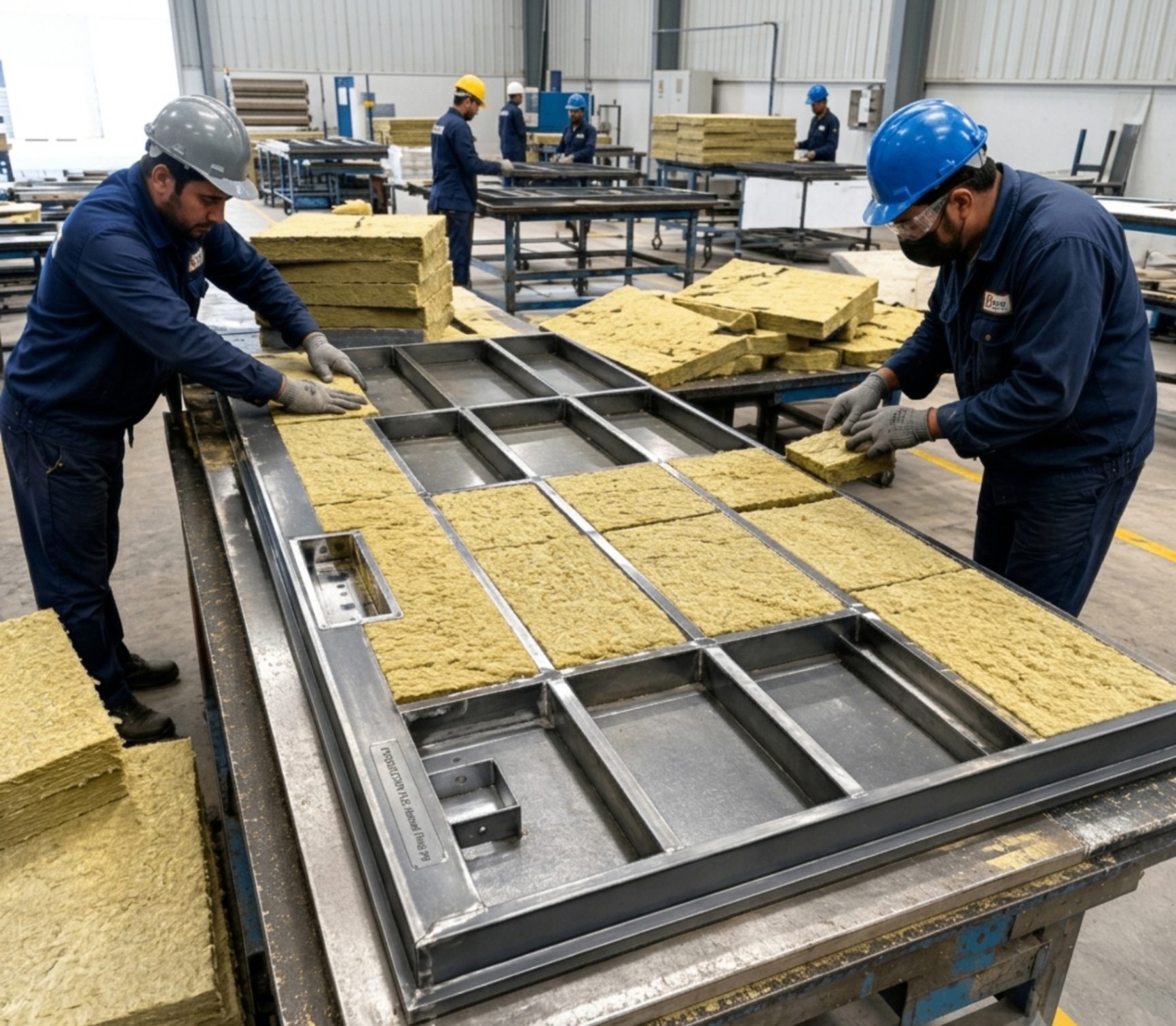
Seals and clearances are a single problem. Clause 9.3.1.1 explains that failure of fire-resisting door assemblies under test can be due to burn-through at the clearance gap between the door leaf edge and the door frame, that doors should be hung to give an equal gap across the head and down both jambs, and that a typical gap to achieve good fire performance is between 2 mm and 4 mm.
The clause then adds the sentence that matters when a smoke seal is specified late: certain smoke seals might require a larger gap in order to operate without causing significant frictional increases, but the gap should remain within tested tolerances. A gasket with too much compression stops the door latching, and a door that does not latch is not a fire door. Adding a thicker seal to an already tight opening changes the assembly rather than upgrading it. Which gap figure governs an Indian doorset is set out in our piece on fire door gap tolerance, and the closer, hinge and latch requirements that sit alongside the seals in our guide to fire door hardware under IS 3614:2021.
Fitting seals on site without voiding the doorset
Clause 9.4.1 is headed Fixing of Smoke Seal and is unusually practical. Where seals must be fitted on site, in the frame or the door edge, the manufacturer's recommendations are to be followed precisely for the type and mode of operation of the door. The groove must be dry and free from dust or sawdust for a self-adhesive seal to bond. The clause then warns that self-adhesive action deteriorates at lower temperatures and that additional mechanical fixing might be necessary below 10 °C, and that surface-mounted seals, while permissible if sufficiently thin, are more prone to detachment than those fitted into grooves.
Clause 9.2.1.2 covers the junction between the doorset and the surrounding structure, which should be adequately sealed to maintain the fire resistance of the wall. It sets the opening tolerance at 5 mm on all three sides, tightening to 2.5 mm for partitions, and expects the residual gap to be masked with an architrave or fire stop sealant. A sealed leaf in an unsealed opening protects nothing, which is the same assembly logic that runs through the way a doorset is built and inspected.
The smoke test the Indian standard does not name
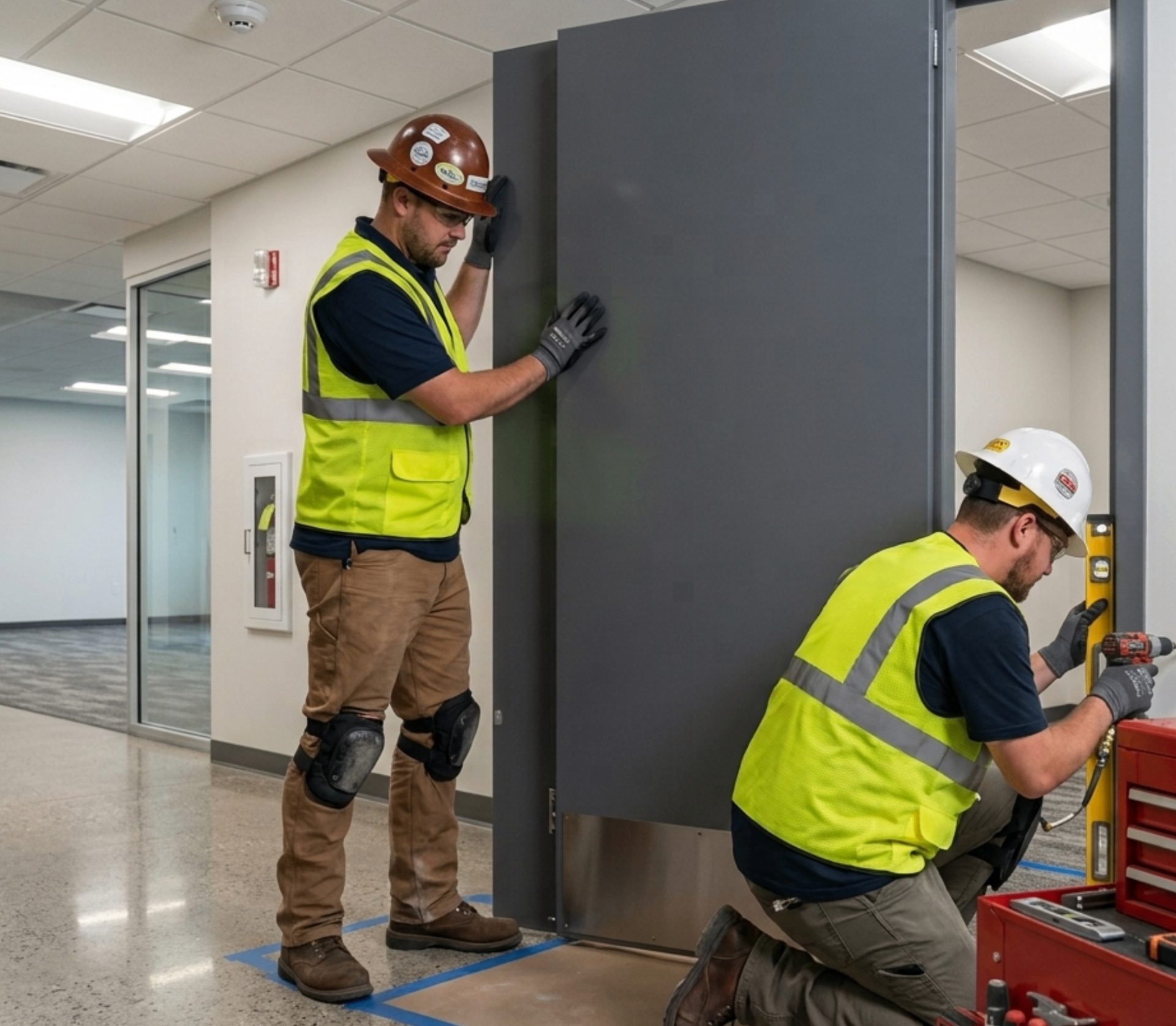
Here is the open edge. Clause 7.6 states that the performance of fire doors shall include smoke check, and Clause 3.27 refers to a draft control test when it defines the EPDM gasket, but IS 3614:2021 does not set out a smoke leakage test method or a pass figure. Its normative references cover fire resistance, through IS/ISO 3008-1:2019 for door and shutter assemblies, and the hardware standards for hinges, closers and handles. There is no Indian leakage class equivalent to the smoke ratings used in other markets.
The international method is ISO 5925:2025, Smoke-control door, shutter assemblies and self-closing glazed elements, which covers ambient-temperature and medium-temperature leakage tests and supersedes ISO 5925-1:2007. It deliberately sets no acceptance figure; permissible leakage rates come from the controlling authority. For an Indian project that means the specification has to do the work the standard leaves open, by naming the test the smoke seal has been subjected to and the conditions it was tested under.
The code side points the same way. National building code Clause 2.22, Note 3, requires fire doors in exits to be provided with an intumescent seal or such other globally accepted technologies and devices, and the same clause carries the 30 min minimum insulation criterion. Pressurized staircases and lobbies are precisely the condition under which Clause 7.6 turns the optional bottom seal into a necessary one. We have read those clauses opening by opening in our guide to fire door requirements in high-rise buildings.
Primary texts are worth keeping to hand: the full text of IS 3614:2021 published for public access, and the BIS product manual for IS 3614, which sets out what a licensee must verify in house.
Frequently asked questions
Does a fire door in India need both an intumescent strip and a smoke seal?
Yes. Note 1 to Clause 7.2.6 of IS 3614:2021 states that all fire doors are required to have smoke seal and intumescent seal as standard components of the door assembly. Clause 7.2.9(d) separately requires all fire doors to be equipped with proper EPDM smoke seals to limit the spread of smoke, and Clause 7.6 requires fire rated smoke check sealing on every type of fire door, swing, sliding and rolling shutter alike. The intumescent requirement at Clause 7.2.6 is written as mandatory for insulated doors.
What is the difference between an intumescent seal and a smoke seal?
Temperature and timing. IS 3614:2021 Clause 3.53 defines the intumescent seal as one that only becomes active when subjected to elevated temperature, expanding to fill gaps when heated above ambient. Clause 3.27 defines the EPDM gasket used as a smoke seal as one that prevents movement of smoke from one side to the other in a draft control test, which it does at room temperature from the moment the door closes. Clause 7.2.6 requires the intumescent seal to be independent of the smoke seal even when the two are supplied together.
Where should the intumescent seal be fitted on a fire door?
Clause 7.2.6 requires intumescent seals on all three sides of the door leaf and on the meeting stile of a double leaf door, or as per test evidence. The alternative it permits is fitting them to the frame and the meeting stile instead. Whichever arrangement is used must match the manufacturer's fire test report in formulation, dimensions and configuration, so the position is decided by the test rather than by the installer.
Is a door bottom seal mandatory on a fire door in India?
Not generally. Clause 7.6 of IS 3614:2021 states that it is not mandatory to have a door bottom seal unless desired or the area under consideration is pressurized. Clause 7.2.4 adds that a bottom seal may not be required for smoke and draft control assemblies. Where one is fitted, Clause 9.3.1.2 asks for even contact with the floor without the friction that would interfere with closing, and caps the undercut gap at 19 mm provided the doorset was tested in that condition.
Can smoke seals be fitted on site?
Clause 9.4.1 permits it and sets conditions. The manufacturer's recommendations must be followed precisely for the door type, the groove must be dry and free from dust or sawdust for the adhesive to bond, and additional mechanical fixing might be necessary where seals are fitted below 10 °C because self-adhesive action deteriorates at lower temperatures. Surface-mounted seals are allowed if sufficiently thin but are more prone to detachment than seals fitted into grooves, which is why the grooved frame profile of Clause 7.2.4 matters.
What size intumescent seal does IS 3614:2021 specify?
For wooden composite doorsets, Clause 7.3.3 gives a minimum of 10 mm wide by 4 mm thick for a 60 min door and 15 mm wide by 4 mm thick for a 120 min door, while also stating that the seal should be of adequate size as per the sample tested at the laboratory. For metallic doorsets, Clause 7.2.6 gives no dimension at all and defers entirely to the fire test report. The size on the certificate is therefore the specification, and a generic figure taken from a catalogue is not.