
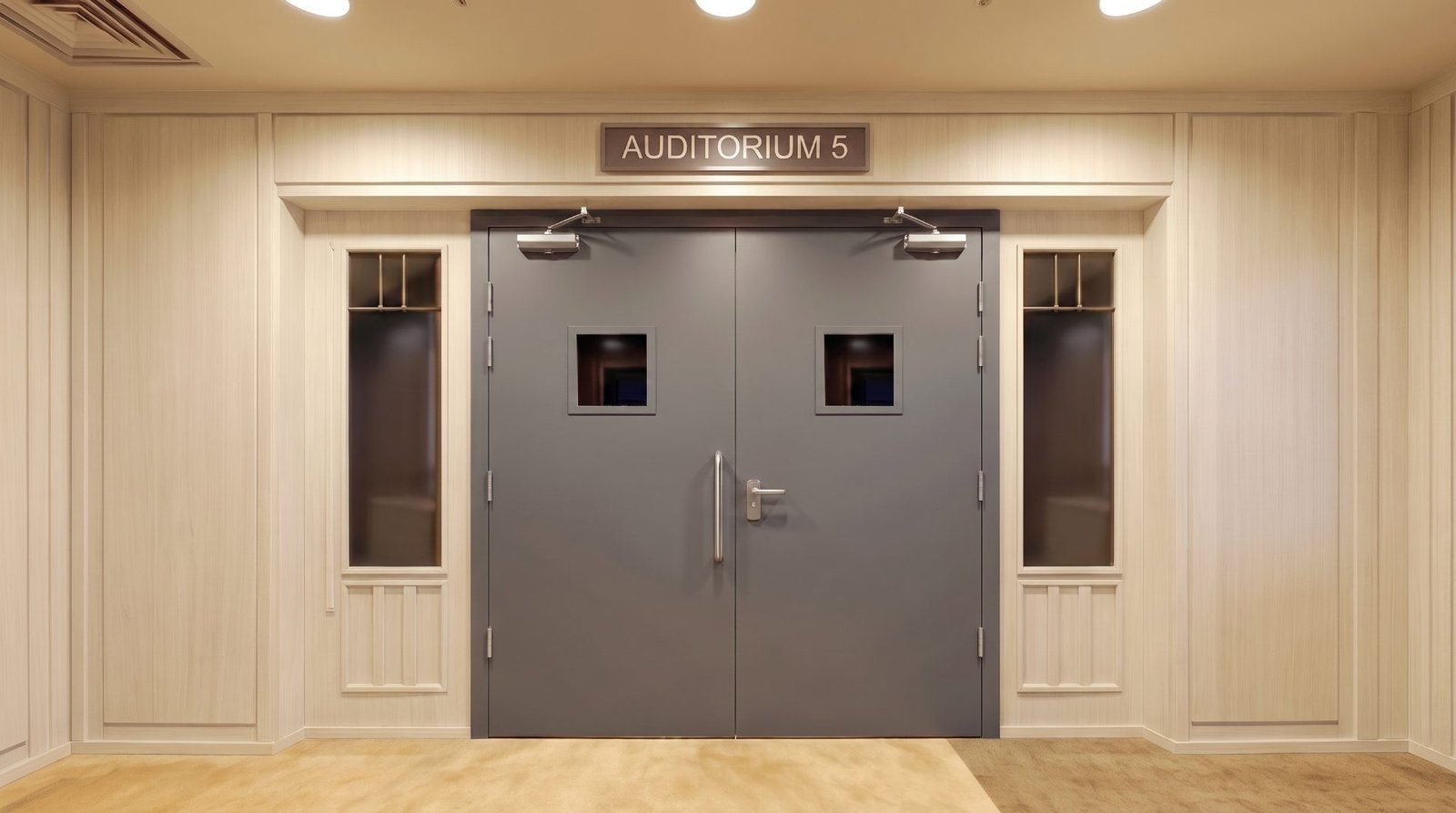
An acoustic fire door is a single doorset carrying two independent ratings: a fire resistance rating tested to IS 3614:2021, and an airborne sound insulation rating measured in a laboratory and expressed in decibels. Neither number implies the other. A doorset can hold FD120 and still leak speech, or stop 50 dB and fail a fire test in twenty minutes.
That is the whole problem with specifying one. Two standards, two laboratories, two certificates - and several of the construction details that earn the acoustic number work directly against the ones that earn the fire number. This guide sets out both test regimes as Indian standards define them, then the four places where the two requirements collide on a real doorset.
Why page one does not answer this in India
Search acoustic fire door and the results are almost entirely product pages - manufacturers listing a dB figure beside a fire rating, with no test standard named beside either. The technical guidance that does exist is British, written around BS 476 and BS EN ISO 10140, and it treats the acoustic number as though it were self-evident.
It is not self-evident. A decibel figure on a door is meaningless until you know three things: which standard it was measured to, whether it was measured on a doorset or on a bare leaf, and whether the number is a laboratory rating or a site measurement. Indian standards answer all three, and almost nobody cites them.
Two ratings, two test regimes
1. What the fire test actually measures
The governing document is IS 3614:2021, Fire Doors and Doorsets - Specification, published by the Bureau of Indian Standards in May 2021 and carrying Amendment No. 1. It replaced the older two-part arrangement, and we broke down what changed in the guide to IS 3614:2021.
The criteria the furnace applies come from the resistance-test part that preceded it, IS 3614 (Part 2):1992, and they are worth stating precisely because they explain the construction. Integrity fails on collapse, on sustained flaming on the unexposed face, on a cotton pad igniting, or when a 6 mm gap gauge passes through a through-gap and can be moved 150 mm along it, or a 25 mm gauge passes at all. Insulation fails when the mean temperature rise on the unexposed face exceeds 140 degrees C above the initial temperature, or any single point exceeds 180 degrees C above initial - and never above 220 degrees C whatever the starting point.
Read those two paragraphs together and the fire engineering follows. Gaps must stay closed while steel expands, so the door needs intumescent seals that swell into the clearance. Heat must not cross the leaf, so the core has to be an insulator with low thermal conductivity. Both requirements push toward a light, porous, mineral core.
2. What the acoustic test actually measures
Sound insulation is measured, not passed. The Indian laboratory method is IS 9901 (Part 3):1981, Laboratory Measurements of Airborne Sound Insulation of Building Elements - the direct national equivalent of ISO 10140-2:2021. The specimen is mounted between two reverberant rooms with flanking transmission suppressed, and the difference in sound pressure level is measured across one-third-octave bands.
Those band results are then collapsed into one number by IS 11050 (Part 1):1984, Rating of Sound Insulation in Buildings and of Building Elements. The method shifts a reference curve in 1 dB steps against the measured values until the mean unfavourable deviation is as large as possible but not more than 2.0 dB; the value of the shifted curve at 500 Hz is the rating. Internationally the same quantity is the weighted sound reduction index, Rw, defined in ISO 717-1.
This is why a single dB figure without a standard behind it tells you nothing. The number depends on the curve-fitting rule, and a leaf tested without its frame and seals will read very differently from the doorset that actually gets installed.

Where the two requirements collide
Four details decide whether one doorset can carry both ratings honestly. Each of them is a place where an acoustic improvement can quietly invalidate a fire test - or the reverse.
1. Mass fights the insulating core
Airborne sound insulation is governed by mass. Double the mass per unit area of a partition and, broadly, you gain around 6 dB. Fire insulation wants the opposite: a low-density mineral core that resists heat transfer, because a dense, conductive leaf moves the 140 degrees C mean rise limit closer, not further away.
The resolution is layering rather than bulk - a mineral insulating core for the thermal duty, with a separate limp mass layer added for the acoustic duty. The Valtrix acoustic doorset is published with a calcium silicate, rockwool and MLV core: calcium silicate and rockwool for fire insulation, mass-loaded vinyl as the limp mass layer. What matters for a specifier is that the layered build is the construction that was tested, in both tests.
2. Sound escapes through the gaps that fire testing needs
A doorset with excellent laboratory performance and a 4 mm perimeter gap will not deliver its rating on site. Sound behaves like air: a small continuous slot around a leaf can dominate the transmission path and cost more than any core upgrade will return.
Fire testing, meanwhile, fixes the clearances. The tested assembly recorded a specific gap, and the intumescent seal was sized to close it. Packing that gap with an acoustic seal that was not in the fire test changes the assembly. The correct sequence is to select seals that appear in both reports - intumescent and smoke seals that are part of the fire evidence, with acoustic compression seals qualified alongside them, not retrofitted afterwards.
3. The threshold is the hardest detail in the doorset
The bottom edge is where most acoustic doors lose their rating. Fire doors are routinely undercut. Acoustic performance needs that undercut closed, which means either a drop seal in the leaf or a raised threshold in the floor.
The published Valtrix configuration uses a bottom threshold with a 4-sided frame, which is the honest approach: a sealed fourth side rather than a leaf hanging over an open gap. It has a consequence worth raising at design stage, because a raised threshold is a trip point and an accessibility issue on a corridor route, and it belongs on the architect's drawing rather than being discovered at installation.
4. Vision panels cut both numbers
Any glazed aperture is a weaker element in both tests at once. Fire-rated glass has to hold integrity, and increasingly insulation, on its own evidence; acoustically, a single pane in a heavy leaf is the transmission path the rest of the door was built to avoid.
Vision panels are permitted on acoustic fire doorsets, and are often required on escape routes, but the size and glass specification have to come from the test evidence rather than from the elevation. The same logic applies to every other item on the leaf - our guide to fire door hardware requirements under IS 3614:2021 covers what certification each fitting needs.
The Valtrix acoustic doorset, as published
For reference, this is the specification published on the Valtrix acoustic fire door page, reproduced without addition:
Applications for this configuration span healthcare, hospitality, education, corporate and public infrastructure - the building types where a wall has an acoustic requirement and the opening in it has a fire requirement, and neither can be traded against the other.
How to verify a claimed dB number
Two further cautions are worth carrying into the specification. First, a laboratory rating is not a site result: flanking transmission through the wall, the ceiling void and the floor will reduce what is achieved in the building, which is why acoustic consultants design to a field target lower than the element rating. Second, the words soundproof and fireproof have no place in a specification. There is no soundproof door and no fireproof door. There are doors with a measured sound reduction index and a rated fire resistance period, and both are finite.
Where an acoustic requirement does not apply, rating selection is a separate exercise - our guide to where FD60 and FD120 belong covers it.
Frequently asked questions
Is an acoustic fire door the same as a soundproof door?
No. Soundproof is a marketing word, not a rating. An acoustic fire door has a measured airborne sound insulation rating, derived in India under IS 9901 (Part 3) and rated to a single number under IS 11050 (Part 1), alongside a separate fire resistance rating. It reduces sound by a stated number of decibels; it does not eliminate it.
Can a normal fire door provide acoustic performance?
Partially, and unpredictably. A fire door has mass and perimeter seals, so it performs better than a hollow internal door. But its core is selected for thermal insulation rather than mass, and it is often undercut at the threshold, which is the single largest acoustic leak. Without a limp mass layer and a sealed fourth side, a standard fire door should not be assigned a dB figure in a specification.
Does adding acoustic seals void a fire certification?
It can. The fire test evidence records a specific assembly, including the seals and the clearances they close. Adding a seal that was not present in the test changes the assembly, and an inspector is entitled to treat the doorset as unevidenced. Acoustic and fire seals should be specified together and appear in both test reports rather than being added later.
What fire ratings are available on acoustic doorsets?
Valtrix publishes FD60, FD90 and FD120 for its acoustic configuration, to IS 3614:2021. Higher ratings exist in the wider range, but the acoustic build is published at those three. Always confirm the rating against the test evidence for the exact construction, size and hardware being supplied.
What does a 50 dB door actually reduce?
Roughly, it reduces sound energy passing through the element by 50 decibels under laboratory conditions - enough that normal speech on one side is not intelligible on the other. The achieved result in a building is lower, because sound also travels through the surrounding wall, the floor and any ceiling void. Design to the field target your acoustic consultant sets, not to the element rating alone.
Who needs acoustic fire doors most often?
Hospitals and diagnostic suites, hotel corridors and guest rooms, auditoria and recording spaces, classrooms and examination halls, boardrooms, and plant or equipment rooms where noise breakout is a nuisance - any place where a fire compartment line runs through a wall that also has an acoustic requirement.