
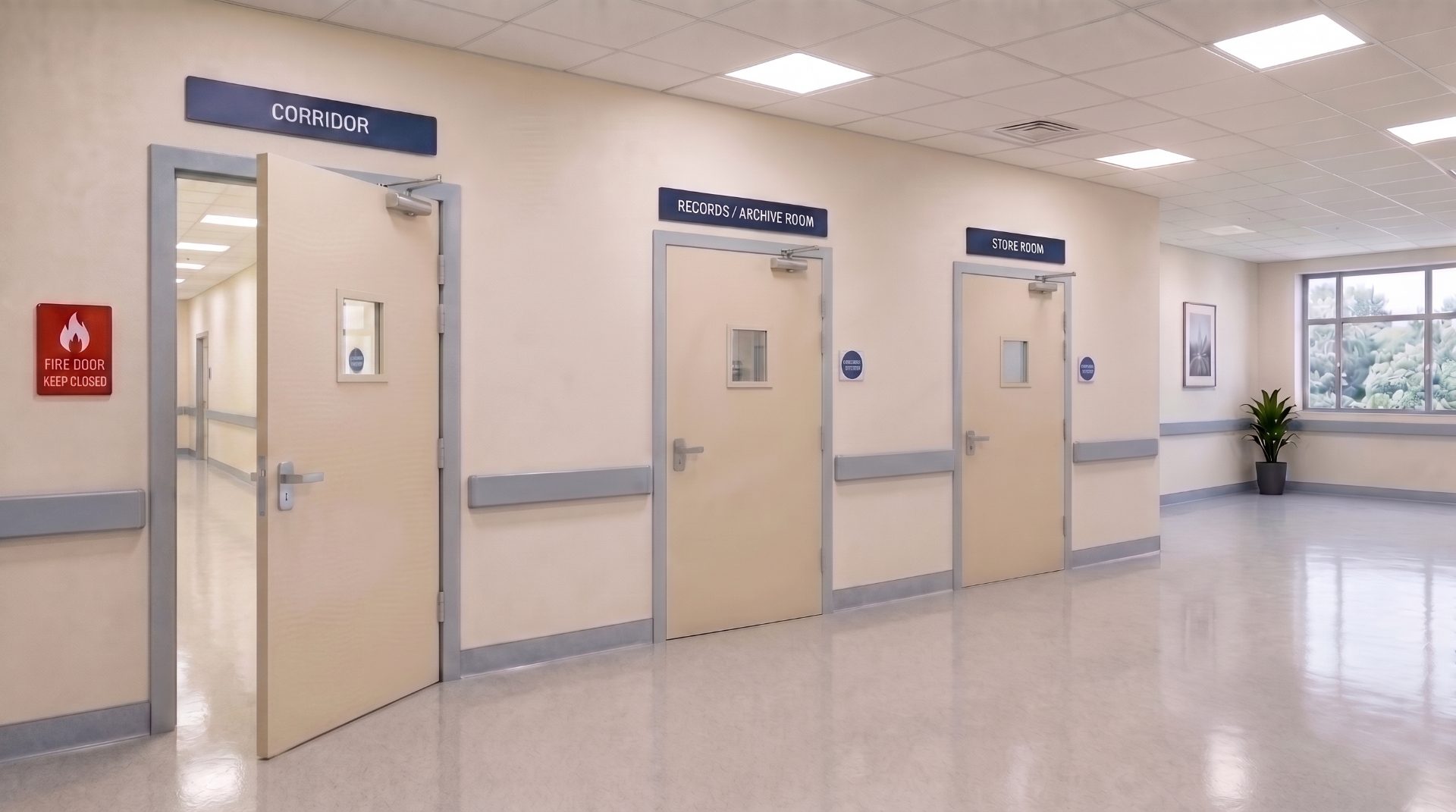
A fire door can carry a vision pane. IS 3614:2021 caps the glass at 0.12 m² on an uninsulated door and 0.06 m² on an insulated one, bars wired glass, and requires the aperture to be cut in the factory. Fire rated door glazing is bounded by the tested specimen as much as by those two figures.
Most of what ranks for this question is written by glass brands and stops at the product. The limits are not in a glass catalogue. They sit in Clause 6 of the door standard, in Table 2 under Clause 7.2.7, and in the scope of the manufacturer's BIS licence, which records whether a vision pane exists at all and how large it is. What follows is each of those provisions, what the 2023 amendment changed around them, and the one category of glazed door that IS 3614:2021 still does not cover.
What Clause 6 actually says
IS 3614:2021 gives vision panes a clause of their own, headed vision pane on fire doors. It opens by permitting them, in plain terms: fire doors can be fitted with glazed vision pane. Everything after that sentence is a constraint, and the constraints fall into three groups.
The exclusion of wired glass is the provision that most often surprises a project team, because wired glass is still sold in India as the cheap fire option and still appears in old specifications copied forward. Clause 6 does not qualify it. A pane of wired glass in a vision aperture is not a compliant pane under IS 3614:2021 whatever its own test history, and the specification clauses are the ones a submittal is read against. We have set out how the standard is organised, section by section, in our walkthrough of IS 3614:2021.
The cap follows the insulation class, not the hourly rating
Clause 7.2.7, which governs metallic hinged doors, says the provision of glazing and glazing material should be in line with the maximum permissible limit outlined in Clause 6, and adds that the hourly rating of the door dictates the type of door and the maximum size of the vision panes used on it. Table 2 under that clause then sets out the limits, and it is organised by door type: an uninsulated door on one row, an insulated door on the other, each with a maximum width, a maximum height and a maximum area. An area under the cap is not sufficient on its own. A tall narrow pane can satisfy 0.06 m² and still breach the height limit in the table, so read both figures against the door type before drawing the aperture.
Amendment No. 1 of July 2023 matters here, because it rewrote the classification clauses that the table keys off. The amendment replaced Clause 5.2 with two sub-clauses, partially insulated (PI) with a minimum insulation period of 30 min and fully insulated (ID) with insulation equal to the integrity rating, and replaced Clause 5.3 so that a door with integrity only, or with insulation below 30 min, is designated uninsulated (UD). Both PI and ID sit under the insulated heading. A partially insulated FD120 PI doorset is therefore an insulated door for glazing purposes and takes the 0.06 m² ceiling, not the 0.12 m² one. Our door range is built around those same three classes, in single and double leaf.
There is one relaxation and it is narrow. Clause 6 allows the overall glass area to be increased by up to 15 percent of the door leaf size where the doorset was tested with larger glass, and states that the increase is not applicable to any insulated door. Where a client wants more daylight through a corridor door, that route exists only on the uninsulated line, and only on the back of a test at the larger size.

Clause 7.3.4 is worth reading even on a steel project, because it explains the reasoning the metallic clauses leave implicit. It states that the size of the glass and the method of its retention are important factors which influence its integrity, that a large sheet tends to collapse earlier than a small one as the temperature approaches the softening point, and that the beading retaining the glass is itself subjected to radiant and conducted heat through the glass. The pane is not a hole in the door with glass in it. It is a small assembly whose glass, bead and fixing were tested together.
What the BIS licence records about your pane
The standard sets the ceiling. The licence sets what a particular manufacturer may actually supply, and a vision pane is one of the variables it names. The BIS product manual for IS 3614:2021, issued as PM/IS 3614/2 in December 2023, is the document that governs how a licence is granted and policed, and it treats the pane as a defining characteristic of the product rather than as an accessory.
In its grouping guidelines, the manual lists among the distinguishing features of a doorset vision pane, with or without, on one or both door leaf and, separately, area of vision pane. It then gives two rules that decide what one fire test can cover. A doorset tested with a vision pane covers doorsets with and without one. A doorset tested with a higher area of vision pane covers doorsets with a lesser area. The logic runs one way only: a test on a solid leaf never covers a glazed one, and a test on a small pane never covers a larger one.
The same two entries reappear in the scope of licence itself, so a licence can be read directly against a submittal. If the scope says vision pane with an area of some value, a doorset delivered with a larger pane is outside the licence even though the model name has not changed. The manual also makes the pane an in-house check at Clause 7.2.7 for metallic doors and Clause 7.3.4 for wooden composite doors, requires vision pane dimensions to be verified against the drawing during production, and lists a change in vision pane size among the events that force a fresh fire resistance test rather than waiting for the five-year cycle. That test is subcontracted to a laboratory recognised by the Bureau and run to IS 3614 and IS 17518 (Part 1), the Indian fire resistance test for door and shutter assemblies that Amendment No. 1 substituted for IS/ISO 3008-1. How the licence, the certificate and the test report fit together is covered in our guide to verifying fire door certification.
The glazed fire door that IS 3614:2021 does not cover
A vision pane in a solid leaf and a fully glazed fire door are different products in Indian certification, and the distinction is easy to miss when both are marketed as fire rated glass doors. The working group that maintains IS 3614 under the Fire Safety Sectional Committee, CED 36, recorded the position in its own agenda papers circulated in September and November 2024: glazed fire doors were removed from the final version of IS 3614:2021 because no Indian Standard for fire-rated glass was available, and they will be included once that specification exists. The draft in question, Fire Resistant Glass — Specification, carries the committee document number CHD 10 (22416) and had completed wide circulation by late 2024.
Two practical consequences follow. First, a claim that a fully glazed doorset is IS 3614:2021 certified deserves the same question as any other claim on a submittal: which product category appears on the licence, and what does the test report describe. Second, the glass standard has been moving, so check the current BIS catalogue before writing a glass specification into a tender rather than relying on a figure in an old document.
The agenda papers record one more unresolved point that affects government work directly. A correspondent observed that schedule-of-rates items for metal glazed fire doors are written around 20 minutes of insulation, while Clauses 5.2 and 5.3 of IS 3614:2021 require a minimum insulation fire resistance period of 30 min for an insulated door, and asked which criterion applies. The committee minuted the question without answering it. Anyone specifying to a public works schedule should expect that gap to surface at technical scrutiny, particularly alongside the 20-minute insulation criterion the National Building Code applies to fire doors in exits, which we set out in our piece on NBC 2016 fire door requirements for high-rise buildings.
Three ways a compliant pane stops being one
None of these involve a defective door. Each takes a doorset that was certified correctly and moves it outside the evidence that certified it.
1. The aperture cut after delivery
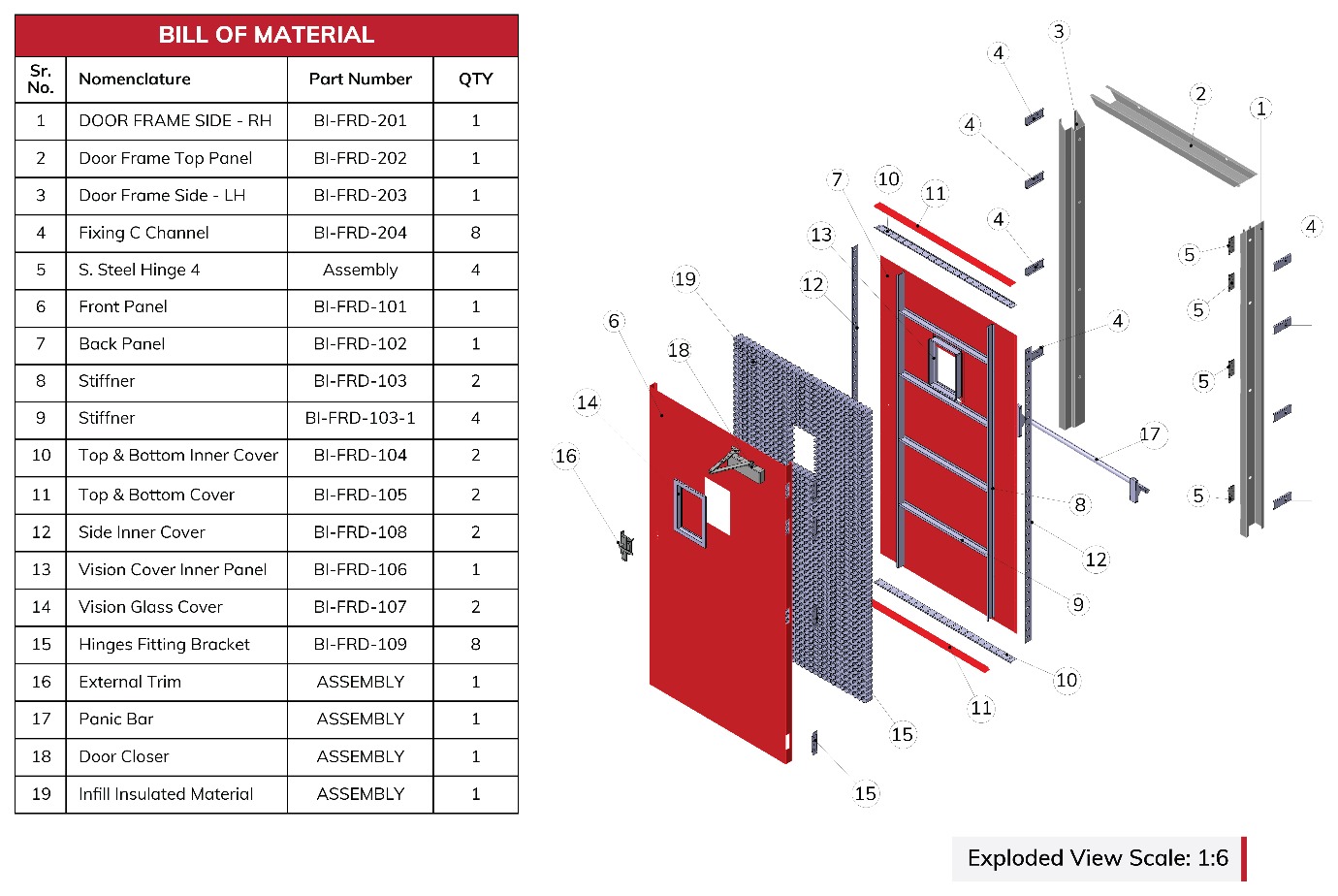
A site decision to add vision panes to doors already delivered, or to enlarge the ones supplied, is the clearest breach in the clause. Clause 6 restricts apertures to doors designed to receive them and states that apertures should not be cut on site. A leaf is an assembly of skins, stiffeners and core; cutting it opens the core, severs stiffeners and removes any possibility of matching the tested specimen. Apertures are formed on the same laser cutting and CNC line that produces the leaf, before the door is closed up.
2. The glass replaced after breakage
A broken pane gets replaced by whoever is quickest, and the replacement is often ordinary float or toughened glass of the same thickness. The door looks correct and is no longer rated. The label requirement in Clause 6 exists for exactly this moment: a pane carrying the maker's label with its intended rating can be verified at a glance, and one without a label cannot be verified at all.
3. The louvre added to a glazed leaf
Clause 7.2.8 states that doors with glass lights, or doors equipped with fire exit devices, may not have louvres. Ventilation requests arrive late, usually from a services package, and a louvre cut into a leaf that already carries a pane breaks the clause even if each element on its own would have been acceptable.

Frequently asked questions
Can a fire door have a glass vision panel in India?
Yes. Clause 6 of IS 3614:2021 states that fire doors can be fitted with a glazed vision pane, subject to limits on area, material and how the aperture is formed. The pane must be within the maximum permitted area for the door class, must not exceed the area or any dimension of the previously tested specimen, and must use glass that stays clear and fire rated for the full duration of the intended test.
What is the maximum size of a vision panel in a fire door?
IS 3614:2021 caps the pane at 0.12 m² on an uninsulated door and 0.06 m² on an insulated door, and states the same figures in the note to Clause 4.1. Table 2 under Clause 7.2.7 adds maximum width and height limits for each door type, so the area figure alone is not sufficient. For wooden composite doors, Clause 7.3.4 sets 0.06 m² with the width or height not exceeding 300 mm. In every case the tested specimen can be the stricter limit.
Is wired glass allowed in a fire door in India?
No. Clause 6 of IS 3614:2021 states that wired glass shall not be used as a vision pane. The clause also excludes interlayered or laminated gel glass that becomes opaque and affects visibility, because the glazing is required to remain clear and fire rated for the entire duration of the intended test. Both exclusions are absolute in the clause, independent of what rating the glass itself claims.
Can a vision panel be cut into a fire door on site?
No. Clause 6 states that a vision pane should only be cut into doors that are designed to receive apertures, under the control of the fire door manufacturer, and that apertures should not be cut on site. A door whose leaf is opened after manufacture no longer corresponds to the specimen that was tested, and the aperture is also a dimension the manufacturer must verify against the drawing under its BIS licence.
Does enlarging a vision panel need a new fire test?
Yes. Clause 4.1 lists a change in the size of the vision glass or vision pane among the changes that require the door to be tested again, and the BIS product manual repeats it as a trigger that overrides the normal five-year testing cycle. The grouping rules work only downwards: a doorset tested with a larger pane covers smaller panes and solid leaves, never the reverse.
Does IS 3614:2021 cover fully glazed fire doors?
Not as published. The CED 36 working group recorded in its 2024 agenda papers that glazed fire doors were removed from the final version of IS 3614:2021 because no Indian Standard for fire-rated glass was available, and that they are to be included once that specification exists. The standard as it stands covers vision panes within a doorset. For a fully glazed doorset, ask which category appears on the manufacturer's licence and what the test report actually describes.