
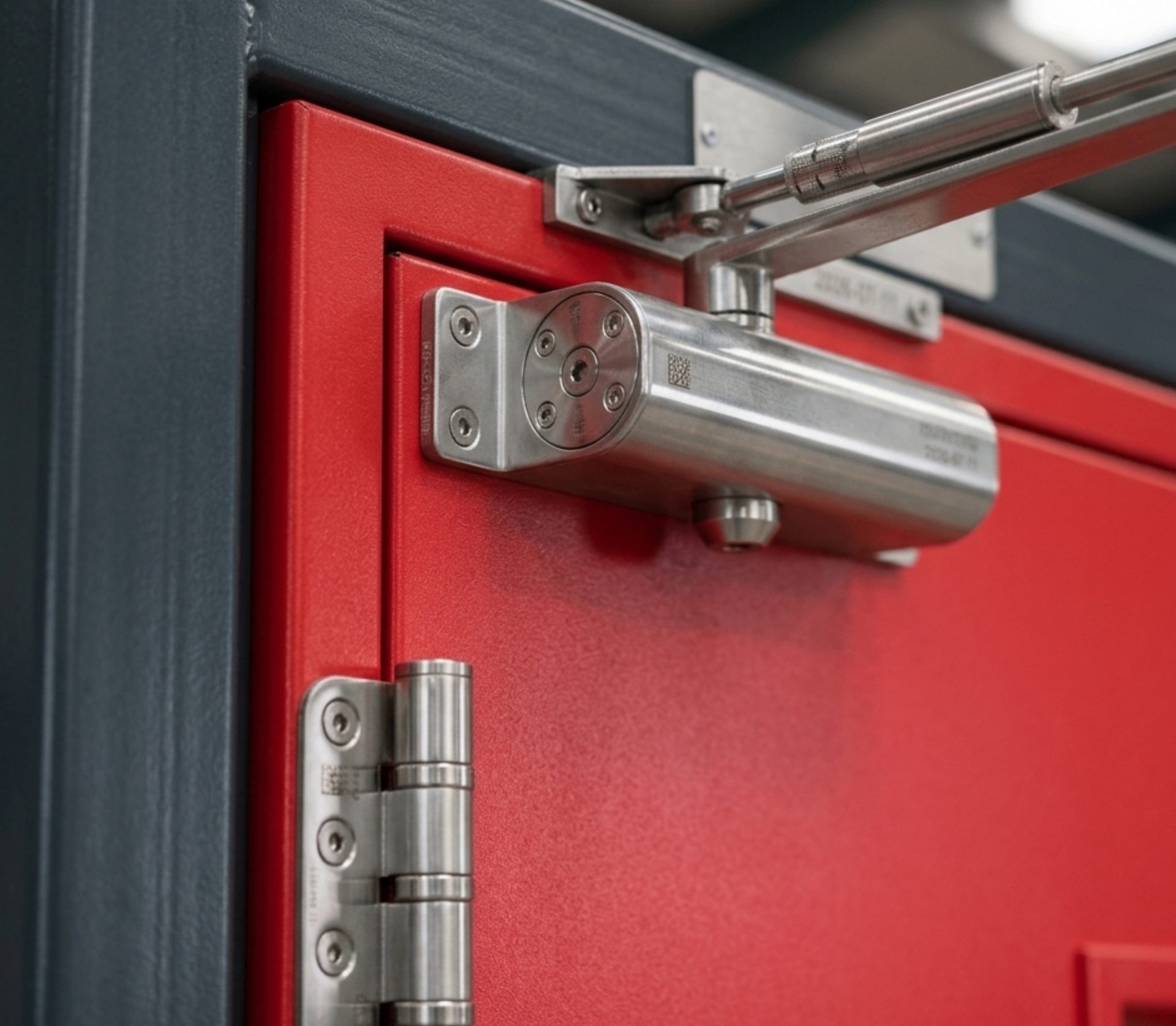
A fire door inspection checklist for an Indian building has to be built on IS 3614:2021 and Part 4 of the National Building Code 2016, not on NFPA 80. The physical checks are broadly the same. The tolerances, the label fields and, above all, the legal inspection frequency are not.
What follows is the checklist itself, the statutory position on how often it has to be run in Maharashtra, and what the written record needs to contain when a fire officer asks to see it.
Why the page-one checklists do not apply in India
Almost every fire door inspection checklist available online is written to NFPA 80 or to UK practice: thirteen points, clearances in fractions of an inch, an annual interval. As a discipline they are sound. As a compliance reference in an Indian building they are the wrong document, for three reasons.
- The product standard is different. IS 3614:2021 is the Indian specification for fire doors and doorsets. It states gaps in millimetres, caps glazed area in square metres, and defines its own label fields.
- The building code is different. NBC 2016 Part 4 decides where a rated door is required and what rating it carries, calling for 120 min fire doors at staircase access (clause 4.4.2.4.3.2), lift lobbies that are not naturally ventilated (clause 4.2.7), firefighting shafts, electrical shafts (clause 3.4.5.4) and MV panel rooms (clause 3.4.6.3), among others. Half of a real inspection is confirming the door in the opening carries the rating the code asks for there.
- The frequency comes from state law, not from the code. NBC Part 4 sets no periodic inspection interval for doors. State fire prevention legislation does, and it is the instrument a fire officer will cite.
How often fire doors must be inspected
In Maharashtra the obligation sits in the Maharashtra Fire Prevention and Life Safety Measures Act, 2006. Section 3(1) requires the owner or occupier to provide measures not less than the minimum requirements prescribed in Part 4 of the National Building Code, and to maintain the fire prevention and life safety measures in good repair and efficient condition at all times.
Section 3(3) turns that into a calendar. The owner or occupier must furnish the Chief Fire Officer with a certificate issued by a Licensed Agency, twice a year, in the months of January and July, confirming those measures are being maintained in good repair and efficient condition. Rule 4(2) of the Maharashtra Fire Prevention and Life Safety Measures Rules, 2009 prescribes that certificate as Form B, and requires the licensed agency to certify that it carried out the inspection, with the report attached.
Two consequences follow. Fire doors are part of what Form B covers, so a door defect found in July is a defect the certificate has to account for. And twice a year is a statutory floor, not an engineering recommendation: a hospital corridor door takes more impacts in a month than a plant room door takes in a year, so most facility teams walk high-traffic openings quarterly and align the full survey to the January and July submission.
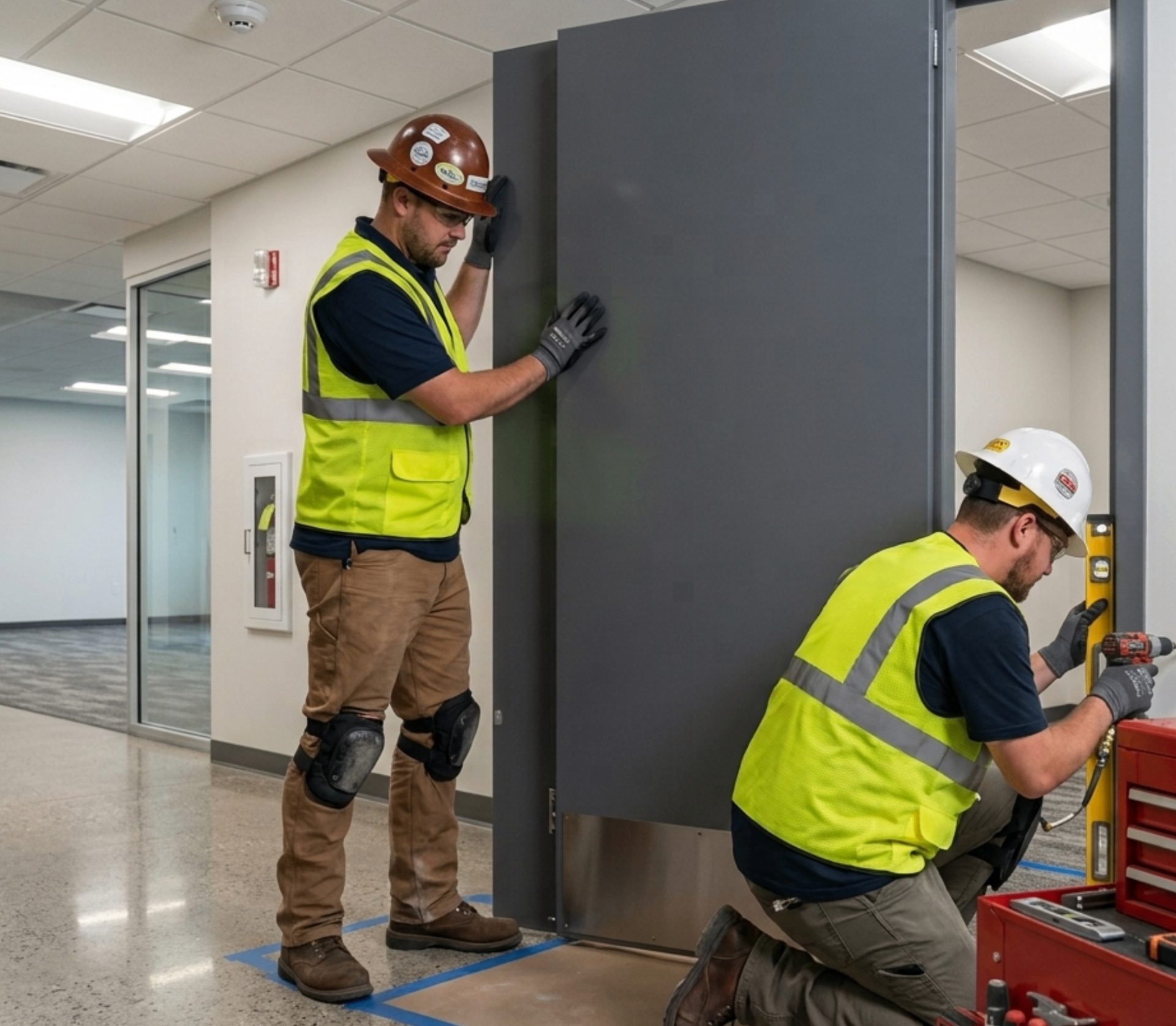
Part one: inspecting the doorset
1. The identification label
Start here, because everything downstream depends on it. Clause 8.3 of IS 3614:2021 lists what the label must carry: name of the manufacturer, type of fire door, fire rating classification, serial number of the door, year of manufacture and certificate reference number. Read all six. A door with a legible serial number and certificate reference can be traced back to a test report; a door without them cannot be verified at all, and that is a finding in its own right.
2. Leaf and frame condition
Look for holes, dents deep enough to have disturbed the core, splits at the edges, corrosion at the bottom rail and damage around the lock case. The doorset is certified as an assembly, so the frame matters as much as the leaf: check it is square, still firmly anchored to the structure, and that the grout or fixing behind it has not been disturbed by later work. Any through-hole that was not part of the tested configuration is a defect.
3. Gaps and clearances
Clause 9.3.1.1 of IS 3614:2021 gives a typical gap of between 2 mm and 4 mm for good fire performance. Measure at the head, at both stiles and, on double leaves, at the meeting edge, with a gauge rather than an eye. Gaps drift as hinges sag, frames move and floor finishes are added after handover. Once a door sits outside the range, the seal geometry the test relied on no longer exists.
4. Hinges, screws and fixings
Every hinge present, every screw in place and tight, no packing improvised behind a leaf. Missing screws are the most common finding on a first survey and the cheapest to close out. Check the hinges are the type the doorset was certified with, and note any swapped during an earlier repair.
5. Intumescent and smoke seals
Clause 7.2.6 of IS 3614:2021 makes it mandatory for the manufacturer to test and supply insulated doors with an intumescent seal, which makes the seal part of the certified assembly rather than an accessory. Run a finger along the full perimeter groove: the seal must be continuous, seated, undamaged and unpainted. Paint over an intumescent strip is a common failure in redecorated buildings, because the strip still looks correct while its expansion is compromised. Where a smoke seal is fitted, check the blade or brush contacts the frame along its whole length.
6. Vision panels and glazing
Confirm the glass is intact, the beads secure and fixed with their original fasteners, and the glazing gasket continuous. Then confirm the panel is the one the certification covers. Clause 6 of IS 3614:2021 caps glazed area at 0.12 square metres for an uninsulated door and 0.06 square metres for an insulated door, so a panel enlarged on site, or glass replaced with ordinary glass after a breakage, takes the doorset outside its certification.
Part two: inspecting how the door behaves
7. The self-closing device
Open the door to its full swing, release it, and watch it all the way home. It must close and latch from any angle without assistance, not drift towards the frame and stop. NBC 2016 Part 4, in the notes to clause 2.22, is explicit that fire doors in exits are not to be left in a hold-open position and are to be closed by a door closure spring mechanism. A closer wound down because occupants complained the door was heavy is a defect, not a setting.
8. Latching
A closed door that has not latched is an open door under pressure. Check the latch engages fully into the strike plate, the strike is aligned, and the lock case has not been replaced with an uncertified unit during a security upgrade.
9. Double leaves and the meeting stile
On a pair, check the closing sequence: the inactive leaf must close before the active one. Where a coordinator is fitted, test it several times. Inspect the meeting stile, astragal and rebate for damage, and measure the meeting-edge gap with the same gauge used at the stiles.
10. Obstruction, hold-open and signage
Walk the corridor as well as the door. Wedges, extinguishers used as doorstops, cable runs through a doorway and furniture parked in the swing are all findings. A hold-open device, where used, must release on detection. NBC 2016 Part 4 clause 6.1.2(d) requires fire doors to rooms containing flammable liquids to be kept closed and signed on each side with the words FIRE DOOR KEEP CLOSED in 25 mm high block letters.
11. Field modifications
The last check is the one that most often voids everything above it. Look for cut-outs for card readers, holes drilled for cable, letter plates, vision panels added after handover, kick plates fixed with through-bolts, and non-certified panic hardware retrofitted onto a certified leaf. Any alteration outside the tested configuration takes the doorset out of the scope of its certificate.
Recording the inspection
An inspection that is not written down does not exist for Form B purposes. A workable record has four parts:
- A door register. One row per opening: a permanent door reference, location, required rating from the approved fire drawings, rating actually installed, and the label data from check one. Build it once, maintain it thereafter.
- A dated result per door, per inspection. Pass, pass with observation, or fail, with measured gaps recorded as numbers rather than as a tick.
- Photographs of every defect. A photograph of a painted-over seal or a 9 mm head gap closes an argument that a written note will not.
- A remedial log with dates. What was found, what was done, who did it, when it was signed off. Most inspection regimes fail here rather than at the door.
Sort findings by consequence, not by ease of repair. Missing screws, a wedged-open door and a disconnected closer clear in a week. A door of the wrong rating for its location, an unlabelled door of unknown provenance, or a leaf with a cut-out through the core is a replacement decision and belongs in the capital plan.
When a door fails
Many findings are repairable within the certification: replacing missing screws with the correct type, refitting a closer, renewing a damaged seal with the one the assembly was tested with, easing and re-hanging a leaf to bring gaps back inside 2 mm to 4 mm. Record repairs of this kind against the door reference.
Others cannot be repaired into compliance. A door whose core has been breached, a leaf carrying an unauthorised cut-out, a doorset with no traceable label, or a door rated below what NBC 2016 Part 4 requires for that opening all need replacement with a certified doorset of the correct classification. Where a building has a run of these, survey the whole stock first and phase replacement by risk: escape routes and compartment lines before ancillary openings.
Specify the replacement as an assembly, not as a leaf. Valtrix manufactures fire doors certified to IS 3614:2021 in FD30, FD60, FD90, FD120 and FD180 configurations, in fully insulated, partially insulated, uninsulated and acoustic types, single and double leaf. If you are deciding which classification an opening needs, the guide to what an FD rating means and the breakdown of fire door types are the place to start, and our certificates and compliance page sets out the documentation that accompanies a Valtrix doorset.
Frequently asked questions
How often should fire doors be inspected in India?
There is no single national interval. In Maharashtra, section 3(3) of the Maharashtra Fire Prevention and Life Safety Measures Act, 2006 requires a Licensed Agency certificate in Form B twice a year, in January and July, covering maintenance of the fire prevention and life safety measures. Other states set their own requirements under their own fire acts. Many facility teams inspect high-traffic doors quarterly and run the full survey to the statutory cycle.
Who is allowed to inspect a fire door?
For the statutory half-yearly certificate in Maharashtra, the certifying body must be a Licensed Agency under the Act. Routine checks between submissions can be done in-house, provided the person doing them knows what IS 3614:2021 requires and records measurements rather than impressions.
Does NFPA 80 apply to fire doors in India?
No. NFPA 80 is a United States standard with no statutory force in India. The applicable documents are IS 3614:2021 for the door, NBC 2016 Part 4 for where rated doors are required, and the relevant state fire act for the inspection and certification cycle.
What gap is allowed around a fire door?
Clause 9.3.1.1 of IS 3614:2021 gives a typical gap of between 2 mm and 4 mm as the range associated with good fire performance. Measure at the head and both stiles, and at the meeting edge on a pair.
Can a damaged fire door be repaired, or must it be replaced?
It depends on whether the repair restores the tested condition. Replacing missing screws, refitting a closer or renewing a damaged seal with the specified component are legitimate repairs. Filling a hole through the leaf, enlarging a vision panel or fitting substitute hardware is not, because the assembly no longer matches the one that was tested.
What happens if a fire door fails an inspection?
Record it, categorise it by consequence, and act on escape-route and compartment-line doors first. For the statutory certificate what matters is whether the measures are being maintained in good repair and efficient condition, so an open defect with a dated remedial plan behind it is a different conversation from an open defect with no record at all.
Primary sources for this article: the Maharashtra Fire Prevention and Life Safety Measures Act, 2006 on India Code, and the Bureau of Indian Standards listing for IS 3614. For a clause-by-clause read of the product standard, see our guide to IS 3614:2021. For sector-specific requirements, see the industries we supply.